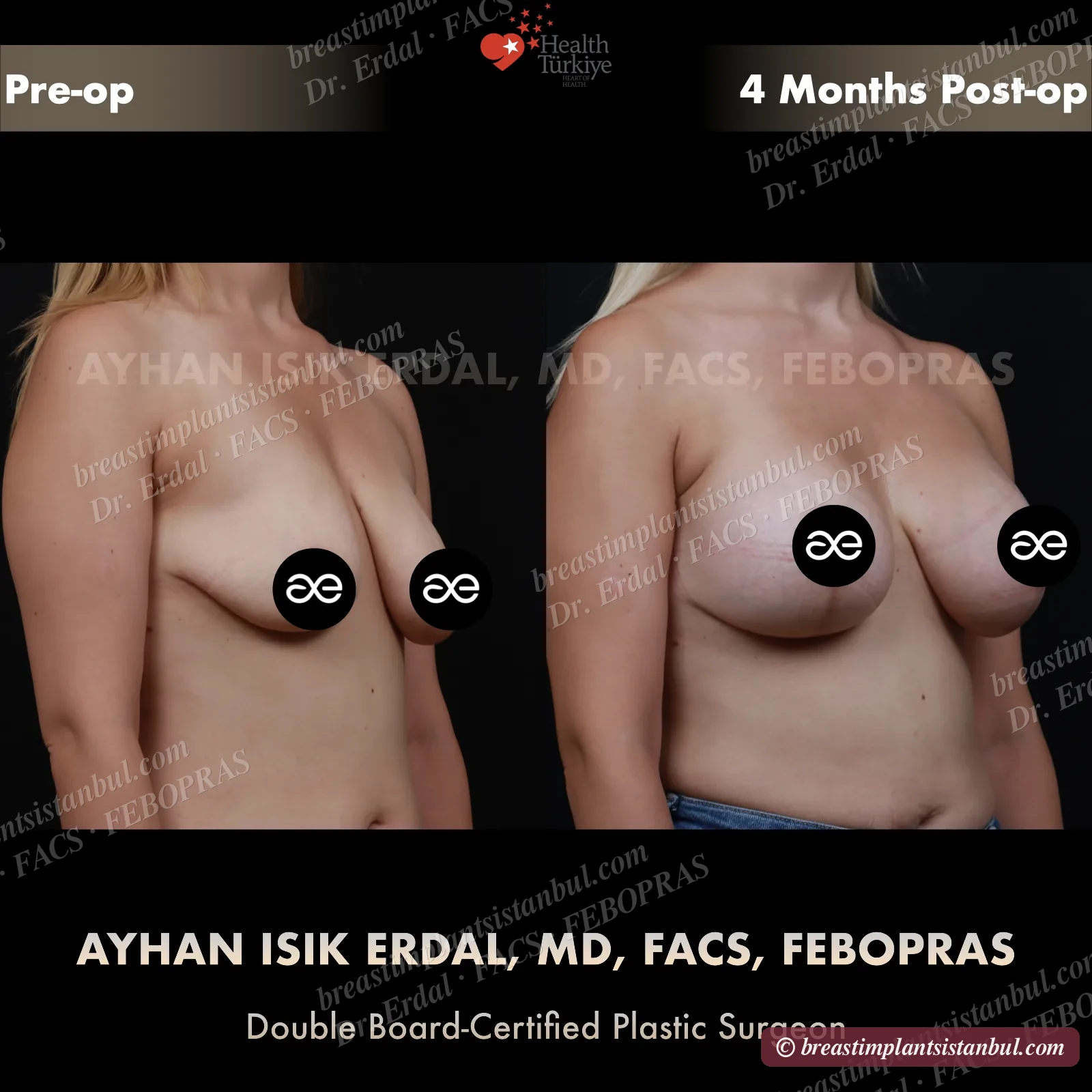
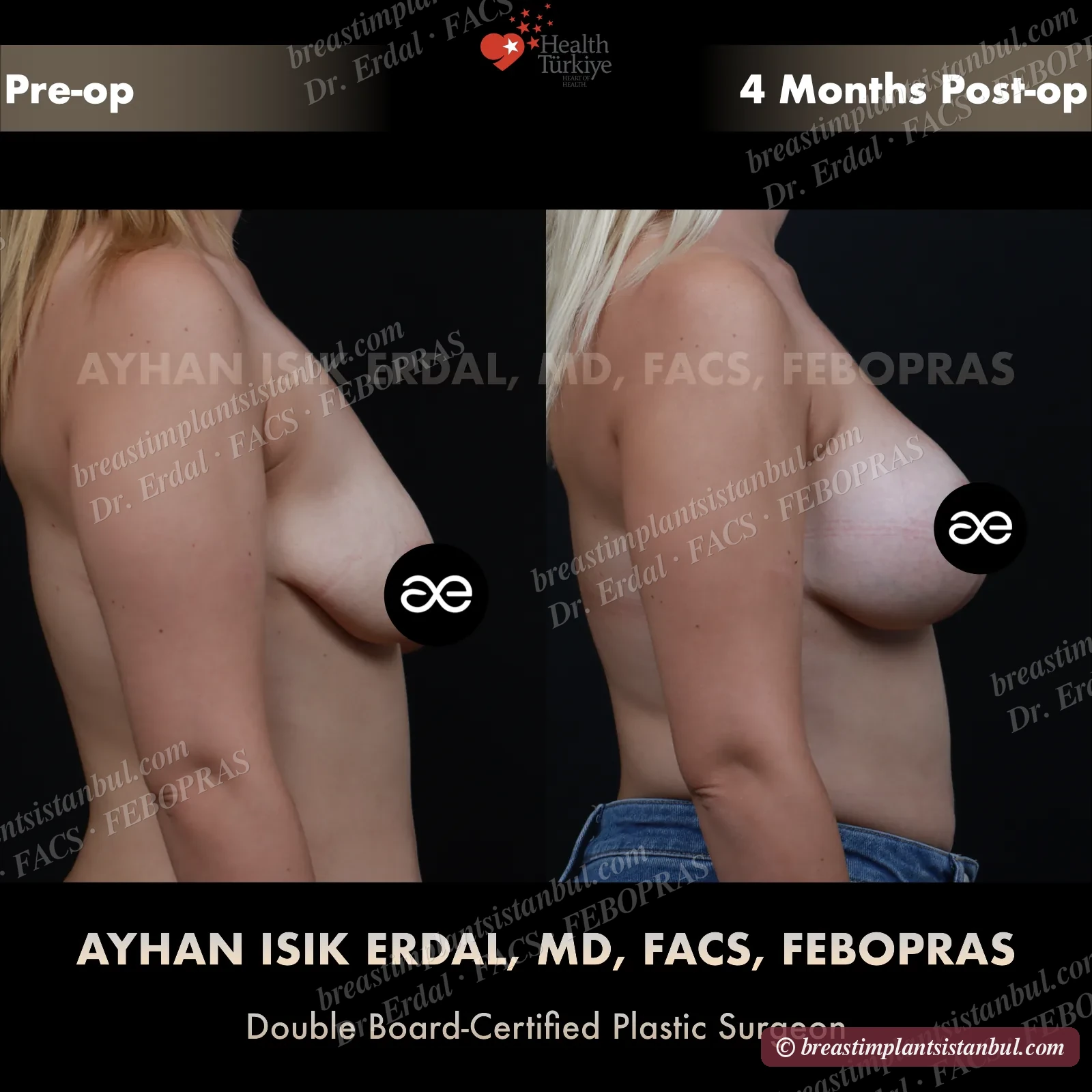
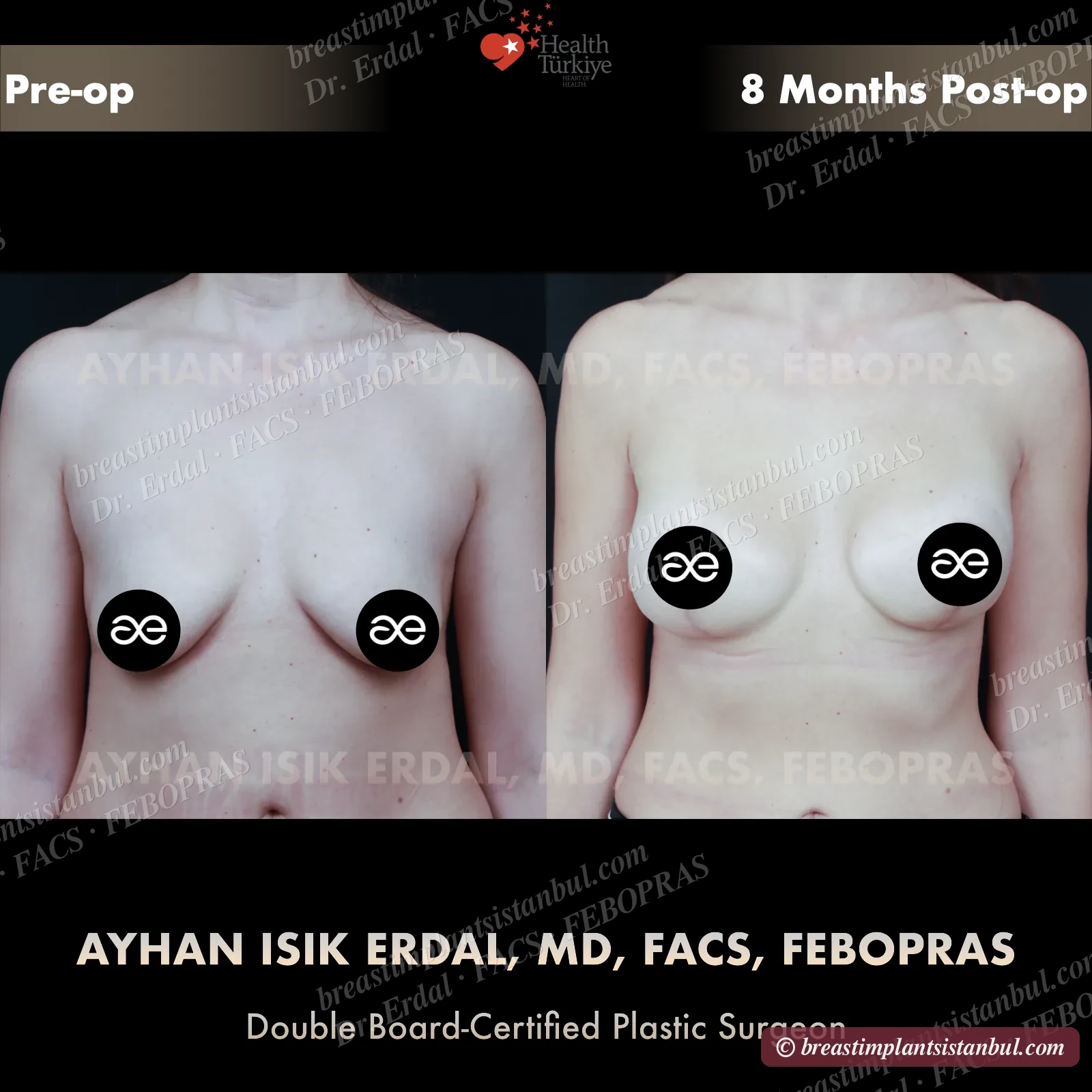
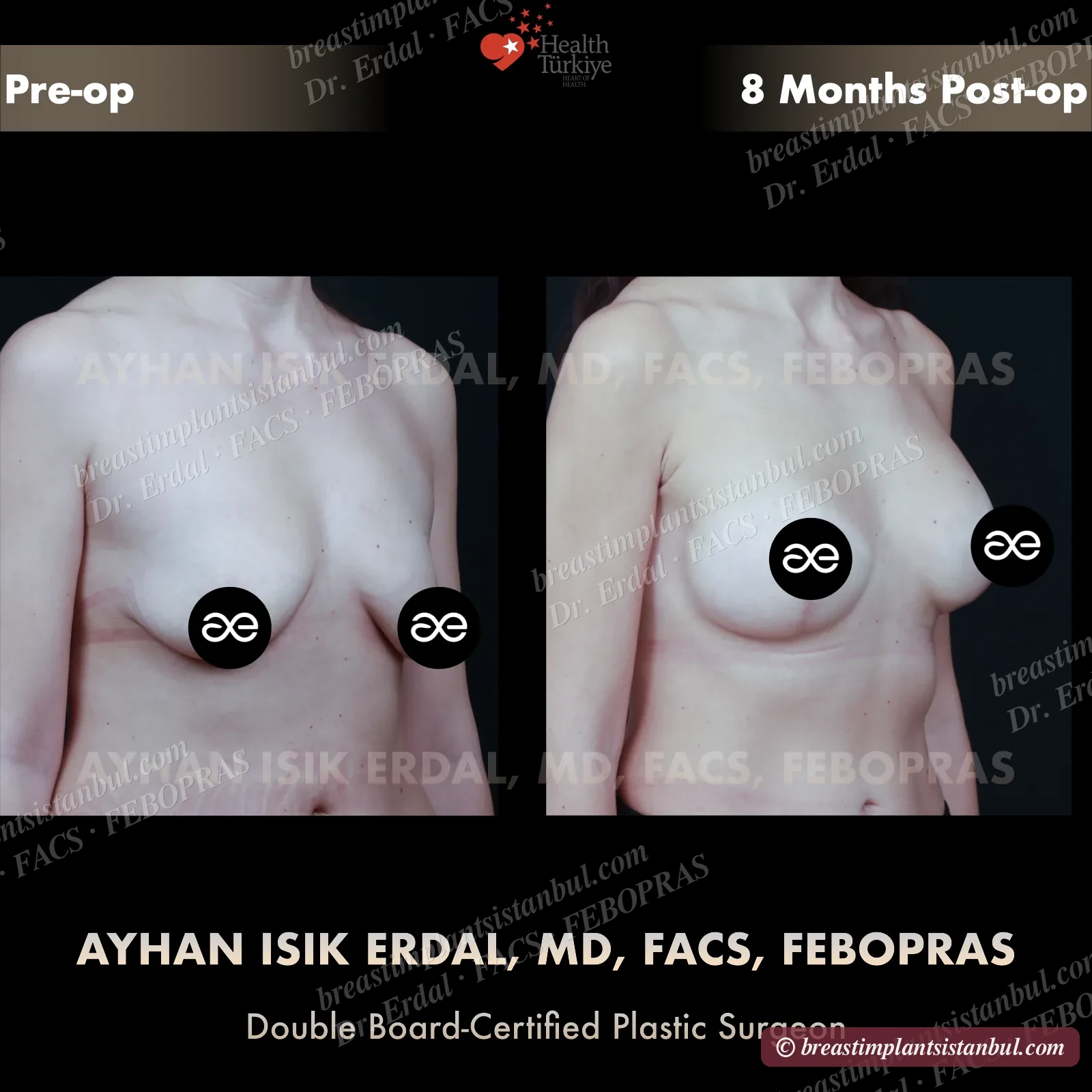
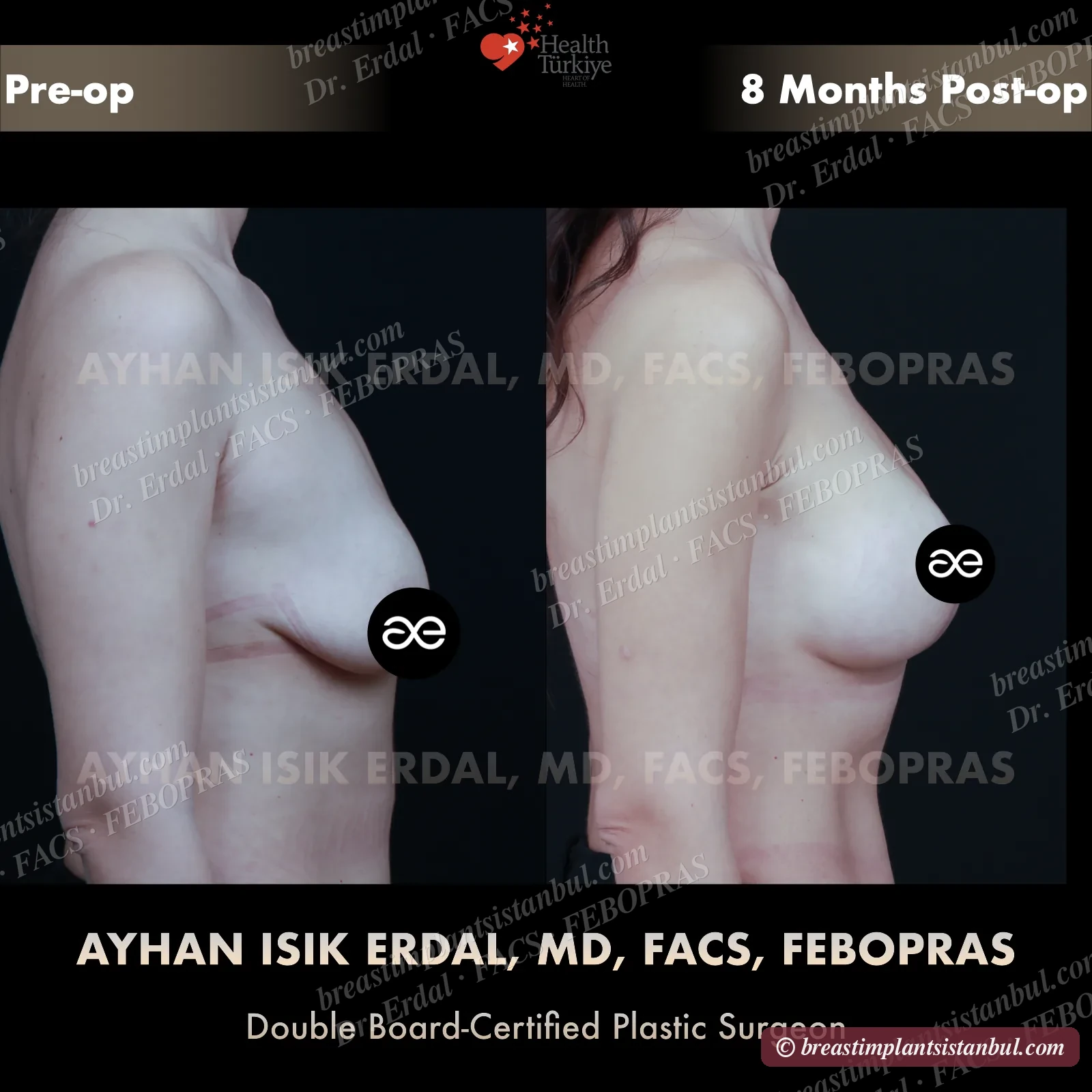
Augmentation mastopexy
For breasts that have lost both volume and position. Combined surgery places implants while simultaneously lifting the breast tissue. Approximately 20% of implant patients.
Augmentation mastopexy (breast lift with implants) is appropriate when the nipple-areola complex sits below the inframammary fold or points downward — anatomic indicators that the breast has sagged. Implant alone in this anatomy worsens the appearance; mastopexy alone leaves a deflated lifted breast. Combined operation lifts breast tissue to a higher position and adds volume with implants in one operation. Single-stage (most common) or two-stage approach. Operative time 2.5-3.5 hours. Recovery 10-14 days for office work, 8-10 weeks for full activity. Final result emerges at 6-12 months as scars mature and implants settle.
Anatomic candidacy
Combined operation is for patients with both volume loss and significant sagging. The clearest anatomic indicator: the position of the nipple-areola complex relative to the inframammary fold.
The inframammary fold test
| Anatomy | Right operation |
|---|---|
| Nipple above the fold, points forward | Augmentation alone |
| Nipple at the fold, points slightly down | Borderline — careful assessment; often combined |
| Nipple below the fold, points down | Combined augmentation + mastopexy |
| Nipple significantly below fold, breast tissue hangs | Combined with vertical or inverted-T scar |
| Severe sagging with very thin or stretched skin | Two-stage approach often safer (mastopexy first, implant later) |
What causes breast sagging
- Pregnancy and breastfeeding — the most common cause. Skin and ligament stretching that does not fully reverse.
- Significant weight loss — including post-bariatric patients. Breast tissue has retracted but skin remains stretched.
- Aging — gradual ligament weakening, skin elasticity loss.
- Genetic predisposition — some patients have looser skin/ligaments inherently.
- Implant explant — patients who had implants removed often need lift due to skin stretch from the prior implant.
What sagging is NOT
- Slight asymmetry between breasts is not sagging.
- Small breasts with the nipple still above the fold are not sagging — these are simply smaller breasts and benefit from augmentation alone.
- 'Tubular' or 'tuberous' breast shape is a different condition (see tuberous breast correction).
Scar pattern decisions
| Scar pattern | Indication | Lift achievable |
|---|---|---|
| Periareolar (Benelli) | Minimal sagging only | 1-2 cm nipple elevation |
| Vertical (lollipop) | Moderate sagging — most common | 3-5 cm nipple elevation |
| Inverted-T (Wise pattern) | Substantial sagging or large breast | 5+ cm nipple elevation |
Vertical scar (lollipop) is the most common in modern combined operation — produces good lift with shorter horizontal scar than the inverted-T. Inverted-T reserved for cases where vertical alone cannot achieve enough lift or where horizontal redundant tissue must be addressed.
Scar fading: substantial fading over 12-18 months. By Month 6-9 scars typically transition from red/pink to white/silver. Visible up close indefinitely. Quality of scarring depends on patient genetics, surgical technique, post-op care (sun protection, silicone sheeting/gel, possibly steroid injection for hypertrophic tendency).
Surgical technique
Combined operation considerations
- Implant decisions same as for augmentation — type, shape, profile, surface, brand. The presence of mastopexy does not change which implant is best for your anatomy.
- Placement typically dual-plane or submuscular — provides best soft tissue coverage given the tissue manipulation in lift.
- Implant size restraint — smaller implants (250-350 cc) typical in combined operation. Very large implants compromise blood supply to the lifted nipple-areola complex.
- Operative sequence — markings made standing pre-op; lift technique performed; implant placed in pocket; final closure with tension monitoring.
Single-stage vs two-stage
| Approach | Operative | Indication | Considerations |
|---|---|---|---|
| Single-stage | One operation, 2.5-3.5 hours | Most patients with adequate tissue, no smoking, healthy | Faster, lower total cost; standard approach |
| Two-stage | Mastopexy first, implant 3-6 months later | Severe sagging; very thin tissue; smoking history; complex revision | Better safety in high-risk; longer total timeline; higher cost |
Single-stage is the modern default — safer than historically due to better technique, smaller implants, and improved blood supply preservation. Two-stage reserved for specific complex cases where it improves safety. A surgeon comfortable with both can recommend the right one for you.
Recovery timeline
All-inclusive cost
All-inclusive packages cover surgeon's fees, JCI hospital, anaesthesia, pre-op tests, hotel 5-7 nights, VIP airport transfers, surgical bra, all in-Istanbul follow-up visits, and 12-month remote follow-up. Premium implant brands (Motiva, B-Lite) add €500-€1,500. Two-stage approach when indicated: total cost spread across two surgical episodes 3-6 months apart.
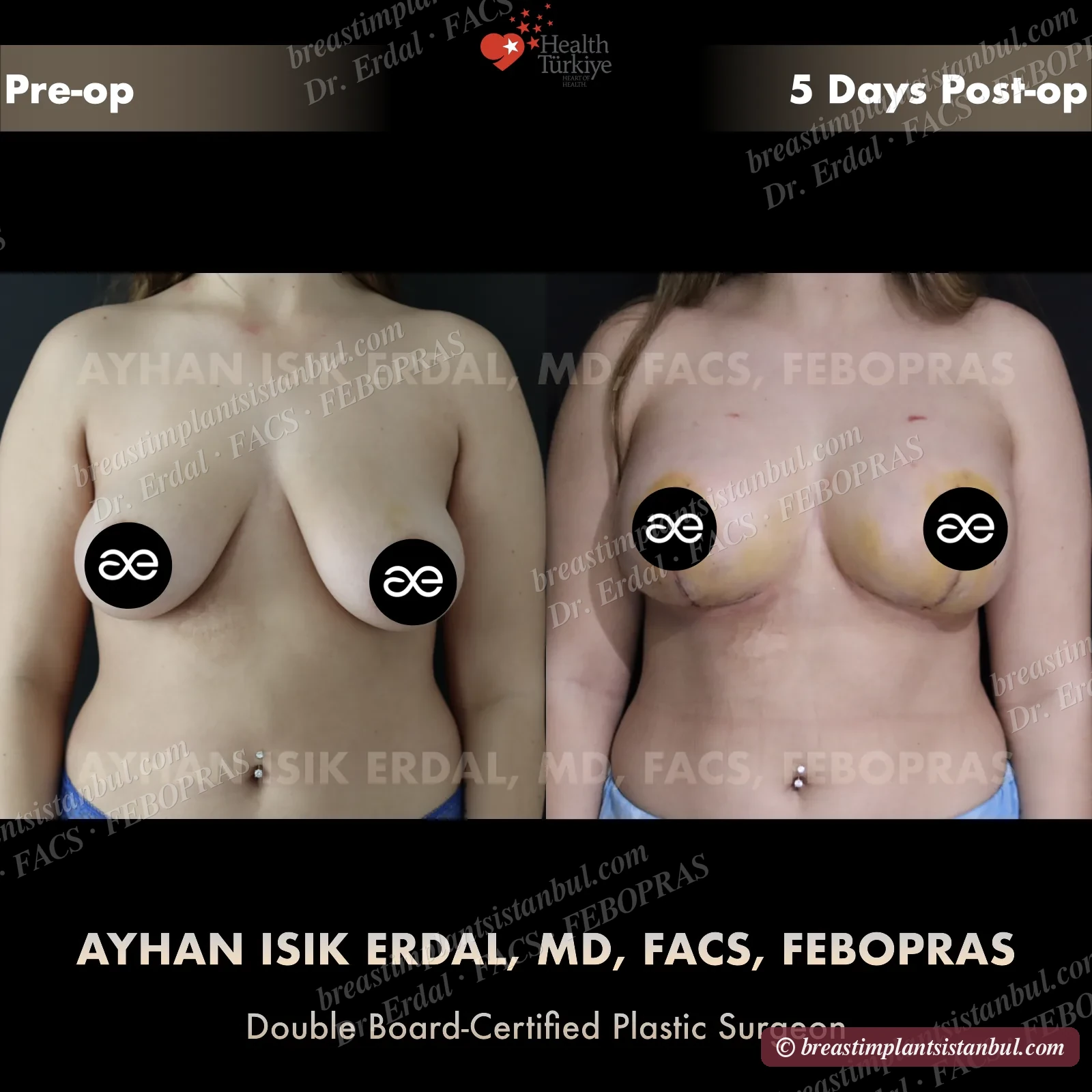
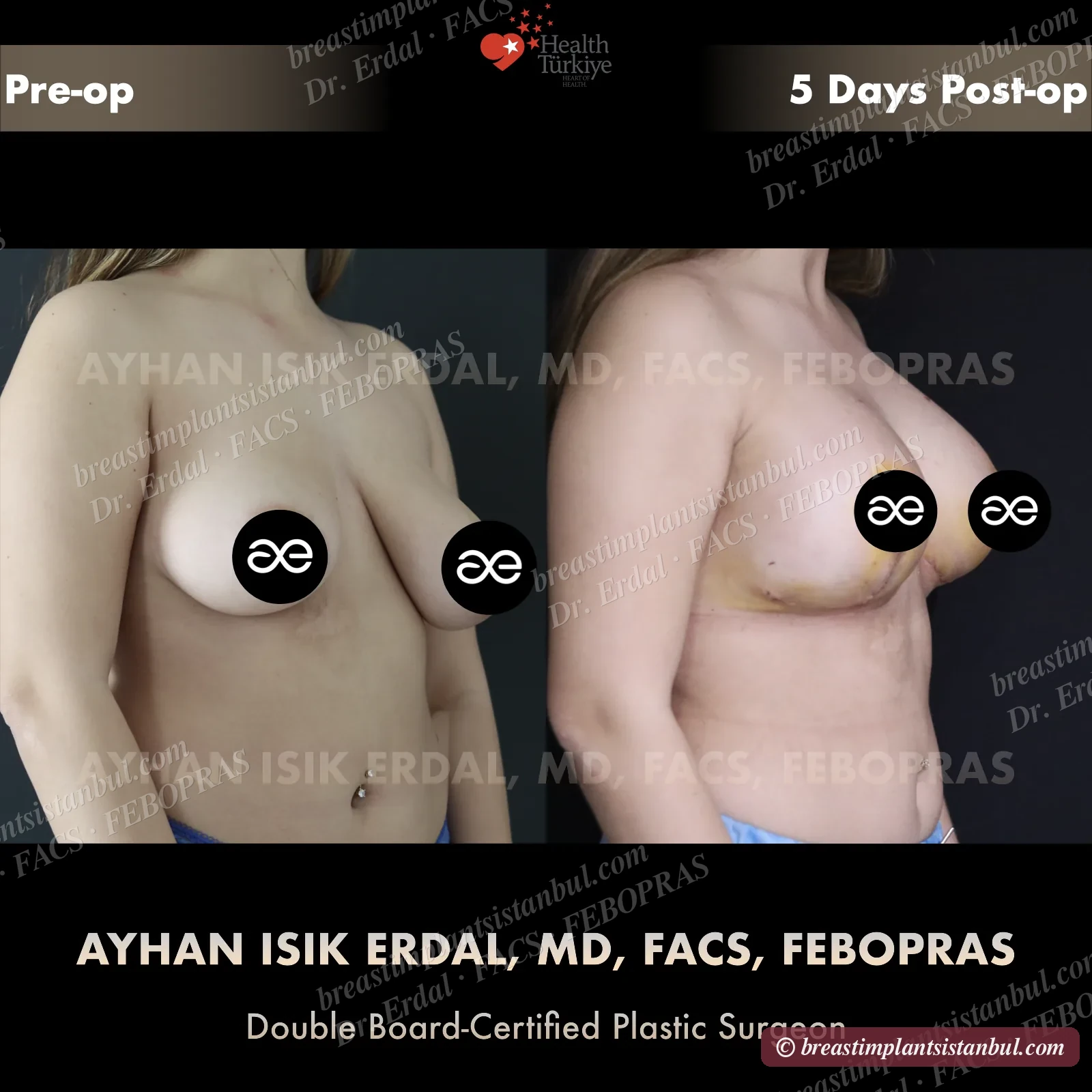
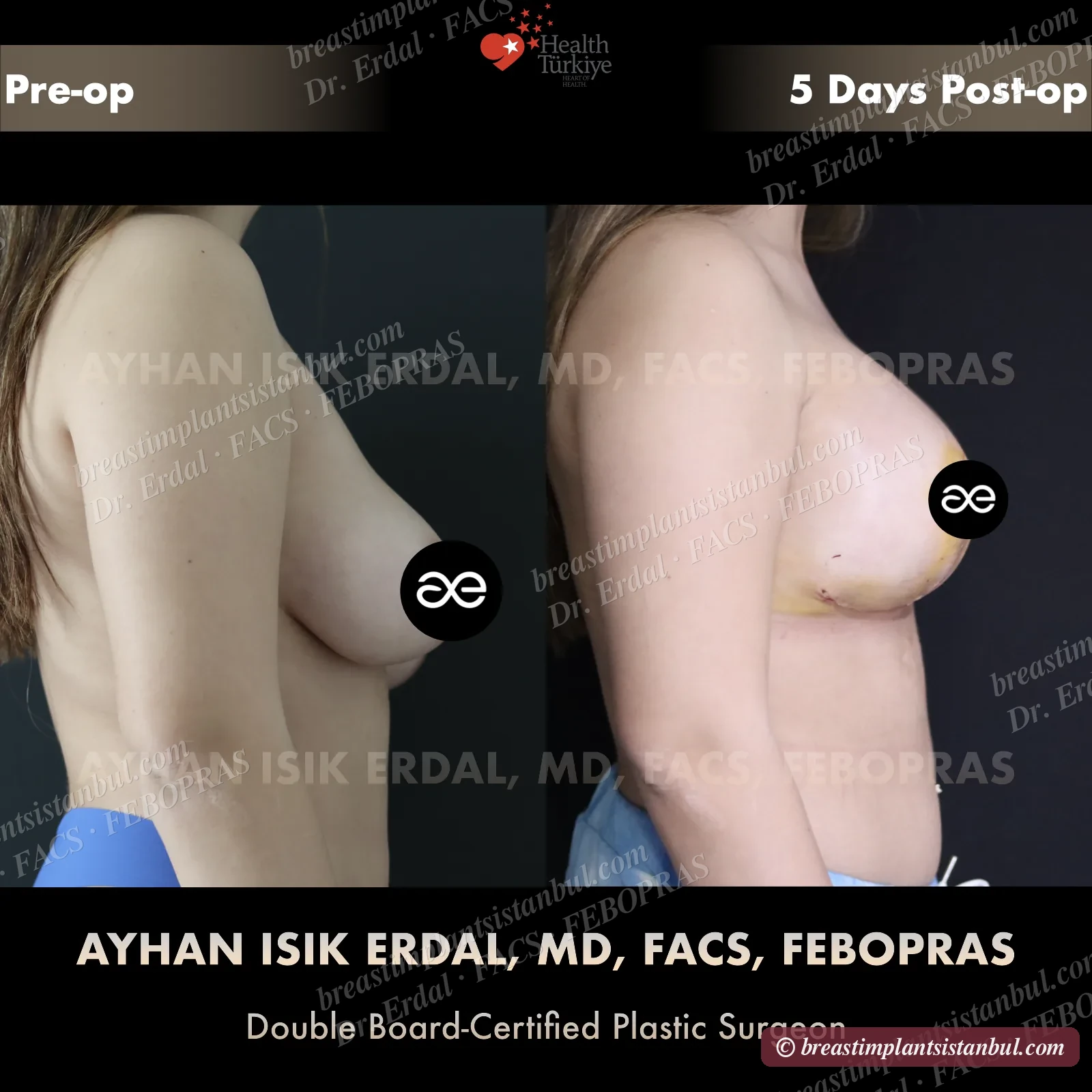
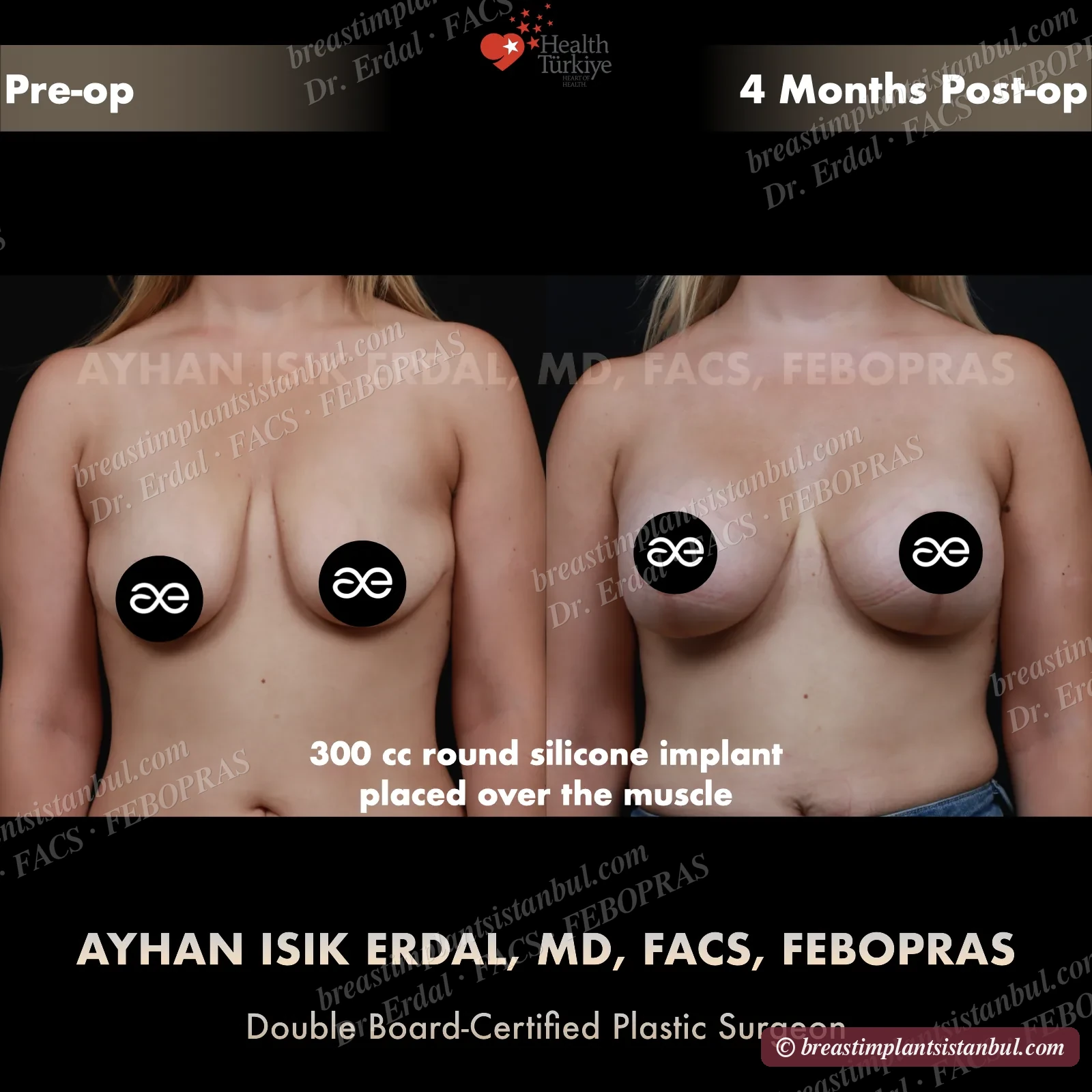
3-case before & after gallery
Combined augmentation + mastopexy results. Each case shows three angles. Note: cases shown at 5 days post-op (early healing window) — final shape emerges at 6-12 months as scars mature and implants settle.